Translate

Sunday, September 2, 2018

A Twenty Five Day Struggle To Save An African Infant's Life

A nine month old girl was transferred to our hospital in respiratory distress after being fed hot porridge by her mother. Was the respiratory distress due to a burn of her larynx or did the porridge enter her lungs? Examination of the larynx revealed a swollen, reddened larynx obstructing her breathing and an endotracheal tube was passed relieving her airway obstruction. In order to prevent the child from removing her life supporting endotracheal tube, she was sedated; a feeding tube was also passed. She developed pneumonia, malaria, diarrhea, abdominal distention and her endotracheal breathing tube came out on the eighth day. At that time, the swelling of her larynx had subsided and she was able to breath. Finally on the twenty-fifth day, after her mother had been educated on feeding, she was well enough to be sent home.


 Examining the infant girl prior to discharge.


 Burned, swollen larynx with endotracheal tube passed through her vocal cords.

                                                             
  Ready to go home.

Thursday, March 22, 2018

Medical Cases from Africa


A four year old presented who aspirated a tamarind seed two weeks before. Every time we tried to remove the large, swollen seed through the vocal cords it would fall off the forceps. Breaking the hard seed into smaller pieces to allow passage was also unsuccessful. Even by paralyzing the patient we could not extract the seed. Keeping the patient sufficiently oxygenated was a problem. An incision was made in his trachea and the seed was removed directly from the wider trachea. The child was discharged healthy in four days.

A 60 year old man presented septic, with a deep neck abscess. He had had a tooth removed six years ago. His x-ray showed a dense object in his peritonsillar region and examination of the oral cavity showed a partially visible object. His neck was drained of 150 milliliters of exudate and removal of the object revealed it to be a round piece of wood with a ceramic base. It looked like a prosthetic crown or the broken end of an oral clamp. The patient denies having had a prosthetic crown put in after his tooth removal; however, it will be shown to the maxillary surgeon for further clarification.

                                          Tamarind Seed

The Advantages of Practicing Otolaryngology in Ghana by an American Otolaryngologist


Practicing otolaryngology for twelve years, the majority of the time as the only otolaryngologist without other specialists in an area of over two million people, has required studying, reading, consulting physicians, accessing Hinari and Youtube. Caring for many sick patients has been the best teacher of all. Helping to restore the health of others resulted in increased confidence and the personal satisfaction of contributing to society.

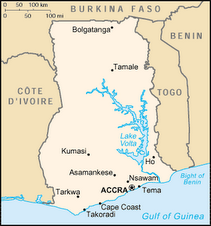
Living, working and sometimes disagreeing with the Dagomba of northern Ghana resulted in appreciating another culture, religion and race. It taught me the common human feelings shared by all men. The Dagombas welcome strangers believing we are enriched by each another. One of their proverbs states that a stranger can do no wrong. They forgive my many mistakes and truly appreciate the little help I have given.


Monday, September 25, 2017

Ways to Improve Our African Hospital

For eleven years I have worked in a four hundred bed Sub-Sahara hospital where needed improvements can only come about through outside funding. The developing country in which the hospital is located cannot afford the cost for these basic improvements. Three main problems are lack of water, lack of oxygen and the cost to the patients for treatment.
The hospital does not have a consistent water supply which causes the inability to sterilize instruments and wash gowns, thereby shutting down surgery. Lack of water prevents laundering of sheets and towels making it impossible to treat patients with diarrhea and prevents patients from bathing and using the toilets, all of which break and are rarely repaired.
Oxygen supply is irregular. After weekends, during which many accident cases occur, oxygen is never available. Surgical cases, even life threatening emergencies, are cancelled. I have bought my own tank of oxygen which I keep to use when needed.

Many times the hospital does not have medications or the patient does not have insurance and the patient’s family has to go to town to purchase the drugs. X-rays, ultrasounds, lab tests, Foley catheters and plates for fracture stabilization must be paid for prior to a procedure being done. Frequently family members contact their village for money which takes critical time and results in delay of care.


This emergency patient had a possible injury to his blood vessels. Because his family could afford to pay for a computer tomography x-ray which did not reveal any injury he was able to avoid surgery.

Sunday, April 23, 2017

Muslim custom unfortunate liability with the use of motorcycles.


Having been here ten years in a referral hospital, many interesting cases come to us. Sadly, several are in the late stages of their diseases and only palliation can be provided. The patients are poor and they first try to obtain a cure from a local healer. Only when in their final stages do they come to the hospital.
 A malnourished child was brought in with his left cheek and jaw necrotic. After being fed he looked and acted stronger. However, he needs the dead cheek and jaw to be removed and his rehabilitation will be far from perfect.
The traditional Muslim custom of the woman wearing a long scarf can become an unfortunate liability with the use of motorcycles. We are seeing accidents in which the scarf gets caught in the wheel and results in strangulation. Such a case presented recently in a woman with a total transection of her trachea from her larynx. Only an emergency tracheostomy saved her life. Her trachea was sewn back to her larynx and now she has a fair air passage. However, both vocal cords are not moving and her nerves may have also been transected with her injury. We are hoping at least one vocal cord will recover.
Because there is minimal dental care, we continue to see many cases of deep neck abscesses from infected teeth.
The custom of drying out groundnuts and corn (maize) on the compound floor allows crawling infants to swallow such items and these young children present choking with food stuck in their trachea.

 We have used our donated facial reconstruction plates on several patients with multiple rib fractures and they did well.


Malnourished child with necrosis of left cheek and jaw.

New form of Transportation
Tamale Teaching Hospital Doctors traveling for Awards

Poor, recovered child whose care was paid for by her doctors